
62
reported wrong-way incidents
RTÉ reported that TII's control centre recorded 62 wrong-way-driving incidents in 2026 through 17 August.
RTÉ reporting on TII dataRoad operations · pilot-stage evaluation workflow
Evaluate AEyeTech on representative road footage: configure the permitted direction of travel, flag a vehicle moving against it, and give an operator the camera, time, location, and event evidence needed to verify the next step.
In one sentenceWrong-way vehicle detection uses camera analytics to track a visible vehicle and flag sustained movement against the configured direction of traffic flow, creating a candidate event for operator verification and response.
EU safety-related traffic information definition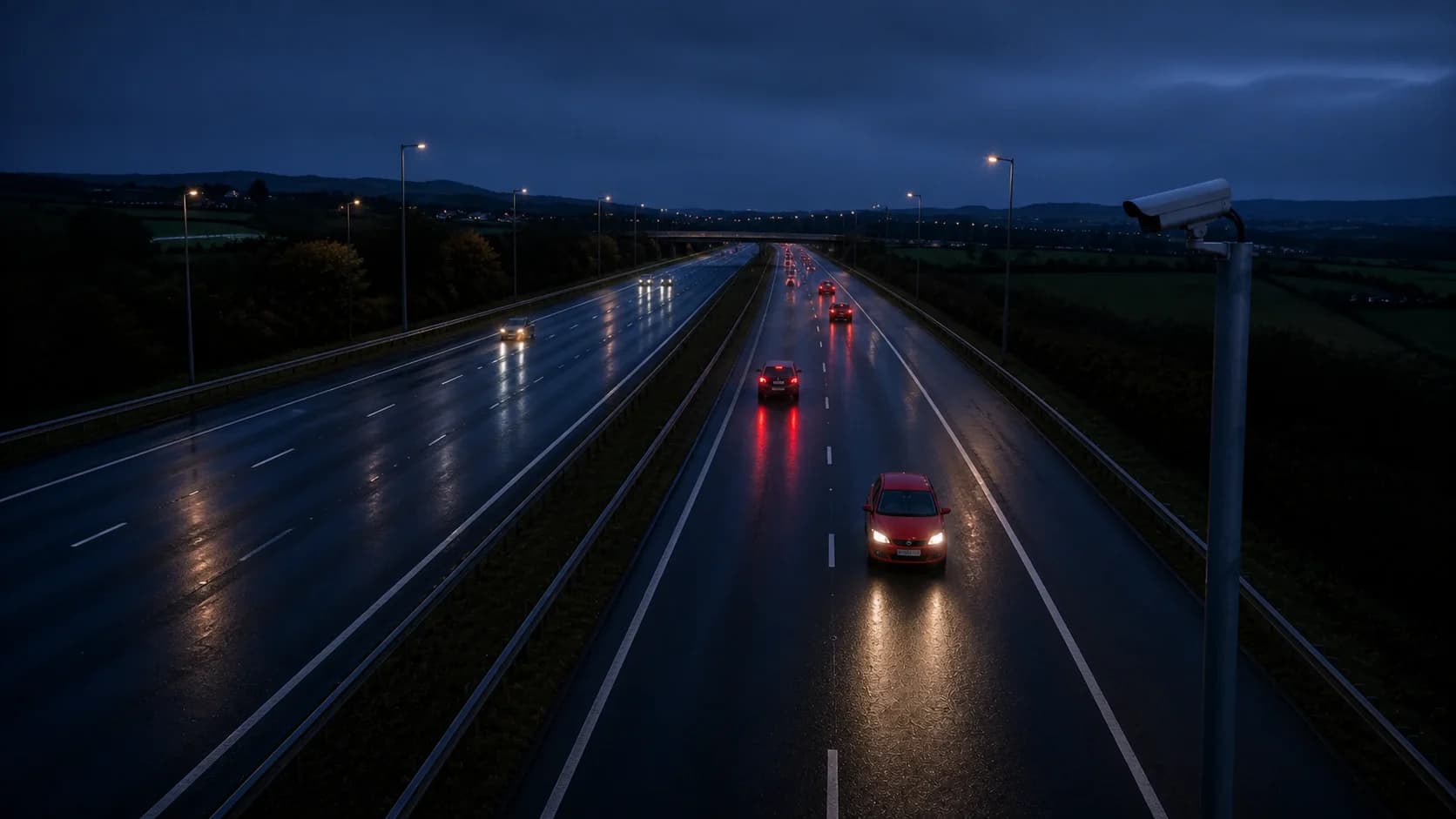
Operator workflow
The model output is not the response. The full workflow must preserve the direction rule, supporting footage, routing decision, and operator disposition.
Define the lane, ramp, or zone and the direction that counts as normal movement for that camera view.
Follow a visible vehicle across enough frames to distinguish sustained opposing travel from noise or a brief manoeuvre.
Package the relevant clip or frames with time, camera, location, and the configured rule that was crossed.
Present the event to an operator and pass approved information into the response path defined for that road environment.
Ireland, August 2026
Ireland already operates national-road CCTV, variable message signs, incident management, and a central control environment. The opportunity for AI is to support earlier awareness inside that wider Safe System—not to replace road design, enforcement, control-room judgment, or emergency response.
Ireland's Road Safety Strategy Phase 262
RTÉ reported that TII's control centre recorded 62 wrong-way-driving incidents in 2026 through 17 August.
RTÉ reporting on TII dataCCTV + VMS
TII describes CCTV, variable message signs, traffic monitoring, incident management, and communications in its network environment.
TII network managementCould be used
On 28 August 2026, Minister Seán Canney said AI with existing road cameras could be used for quicker motorway incident alerts. This was not a procurement announcement.
RTÉ, 28 August 2026Context only: AEyeTech does not claim deployment with, approval by, or endorsement from TII, the RSA, An Garda Síochána, or the Department of Transport.
The useful boundary
A credible system is explicit about the observable event, the evidence it creates, and the decisions that remain with accountable people and authorities.
Deployment shape
Processing location and integrations are selected around latency, connectivity, camera access, governance, and the operating team—not assumed from a generic demo.
VMS, control-room, notification, or traffic-management integrations are deployment-specific and should be verified during technical discovery.
Candidate environments
The strongest first sites have a clear permitted flow, a usable camera angle, representative footage, and an operator who owns the response.
Monitor a defined exit or entry geometry where sustained opposing movement can be separated from normal turning behaviour.
Add a candidate-event signal to environments with controlled camera coverage and an established operating procedure.
Review one-way approaches, restricted lanes, and reversals where the permitted direction is configured by location and time.
Assess confusing exit geometry and other transition points with the road authority before choosing a detection zone.
Proof before performance claims
AEyeTech does not publish a universal accuracy percentage for this workflow. A monitored pilot should measure the full detection-to-operator path on representative footage and report the conditions behind every result.
Share of labelled wrong-way events detected under the agreed rule.
Candidate events that an operator rejects, reported per camera-day.
Time from observable opposing movement to an available operator event.
Performance across the scenes the deployment is expected to face.
Whether stream, analytics, and routing health remain observable.
The effort required to verify, acknowledge, and close each event.
Pilot inputs
Acceptance thresholds should be written before testing. Results remain specific to the evaluated cameras, conditions, configuration, and workflow.
Privacy and operational governance
Road footage and event clips may contain personal data. Edge or on-premise processing can reduce unnecessary movement of raw video, but deployment location alone does not establish compliance.
The responsible organization should document purpose and necessity, decide whether a data-protection impact assessment is required, set access and retention rules, secure exports, and keep the human response accountable.
Read the Irish DPC CCTV guidanceDefine the road-safety task and prohibit unrelated reuse by default.
Use the fewest cameras, fields, clips, and retention needed for that task.
Separate operator, investigator, administrator, and maintenance permissions.
Revalidate after camera, road geometry, model, threshold, or workflow changes.
Buyer questions
These answers describe the evaluation model. Exact support depends on the camera estate, architecture, integrations, and approved operating procedure.
It is a video-analytics workflow that tracks a visible vehicle and compares its movement with the permitted direction configured for a lane, ramp, or zone. Sustained travel against the direction of traffic flow can create a candidate event for operator review.
Potentially. A technical assessment should confirm stream access, resolution, frame rate, field of view, camera stability, lighting, network reachability, and whether the road geometry is visible enough to define direction reliably.
There is no responsible universal percentage. Accuracy depends on the camera, scene, event definition, threshold, weather, lighting, occlusion, traffic pattern, and test set. A pilot should report recall, false alerts per camera-day, latency, sample size, and condition breakdown.
Not as part of this wrong-way detection workflow. Direction detection concerns vehicle movement. Driver identification and automatic number-plate recognition are separate capabilities with different legal, technical, and governance requirements. Event imagery may still contain identifiable people or number plates and may therefore be personal data.
The system can be scoped to route an approved event to compatible downstream tools, but any automatic sign, enforcement, or emergency action requires separate integration, authority, safety design, testing, and operating approval. It is not assumed by this page.
Those conditions must be represented in validation. Poor illumination, headlight glare, spray, occlusion, roadworks, camera vibration, and dirty lenses can affect the usable visual signal. The workflow should surface degraded or missing coverage rather than imply continuous certainty.
Depending on the estate and use case, processing may run at the edge, on controlled on-premise infrastructure, or in a scoped hybrid design. Latency, resilience, bandwidth, security, support, and data governance should drive the choice.
Start with clear lane geometry and direction rules, track movement across enough frames, exclude normal manoeuvre zones, test difficult scenes, and review rejected alerts by cause. Threshold tuning should be versioned and rechecked when the site changes.
The responsible organization should assess lawful purpose, necessity, proportionality, transparency, access, security, retention, sharing, and individual rights. Event clips may contain personal data, so legal and data-protection review belongs in the deployment plan.
Follow current Road Safety Authority guidance: when it is safe to do so, contact An Garda Síochána on 999 or 112 and provide the motorway, direction of travel, location, and a description of the vehicle. AEyeTech is not an emergency-reporting service.
Read the RSA motorway emergency adviceEvidence base
The page separates independent road-safety context from AEyeTech capability. External sources do not certify or endorse AEyeTech.
Reviewed by AEyeTech Editorial ·
Transport Infrastructure Ireland
Ireland's existing control-centre, CCTV, VMS, traffic-monitoring, and incident-management context.
Department of Transport
Safe System approach, data sharing, camera-based enforcement, and technology advancement priorities.
PIARC · World Road Association
Independent overview of video-based incident detection, including wrong-direction movement and error-rate considerations.
European Commission
EU safety-related traffic-information definitions include wrong-way driving events. This is a design reference, not a claim of DATEX II integration.
Road Safety Authority
Public road-user guidance. Technology must fit the authority's established safety and response procedures.
Data Protection Commission Ireland
Irish data-protection guidance for CCTV purpose, necessity, transparency, access, and retention.
RTÉ News
Current reporting of TII control-centre figures and the existing incident-notification process.
RTÉ News
Current, attributed statement that AI with existing road cameras is under consideration; not an AEyeTech procurement or endorsement.
A measured starting point
We will help map the camera view, permitted direction, evidence, latency target, operator decision, and validation plan before anyone discusses scale.